Spacecraft & Propulsion / EXPLAINER
How a Spacecraft Points Without Turning Its Orbit
Understand reaction wheels, pointing sensors and momentum management, and why aiming a spacecraft is a different job from changing where it travels.
FREE EXCERPT
Position and pointing answer different questions
An observatory can be in the correct orbit while its telescope points away from the target. A communications spacecraft can follow its intended path while its antenna misses Earth. Position describes where a vehicle is; attitude describes its orientation. That distinction is essential when interpreting reports about spacecraft control. A pointing problem does not, by itself, mean that the spacecraft has left its orbit.
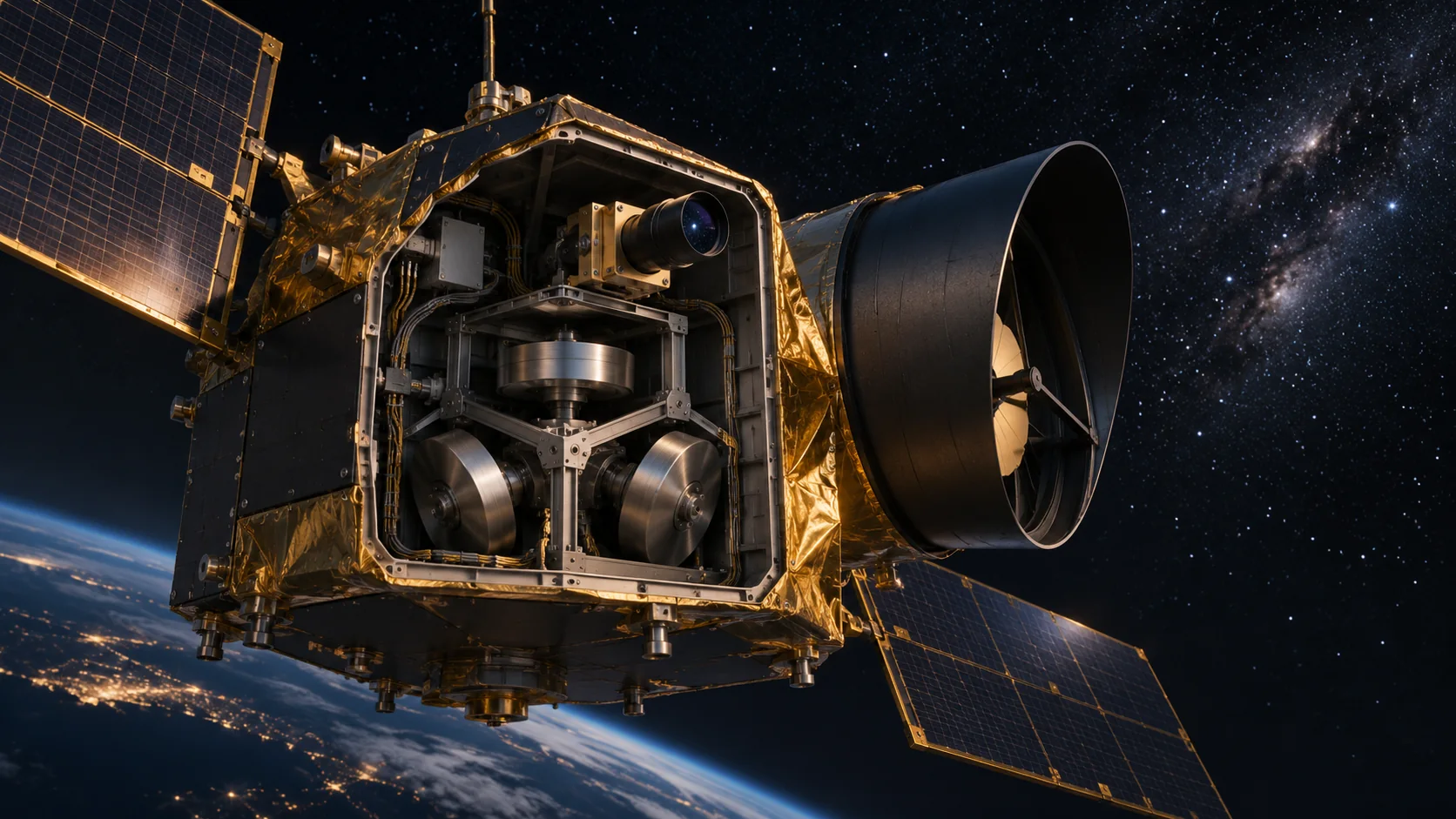
NASA's guidance, navigation and control survey describes sensors and actuators that work together to determine and change orientation. Reaction wheels are among the actuators: changing the rotation of an internal wheel produces a corresponding response in the spacecraft. NASA's onboard-systems guide contrasts internal spinning wheels with small thrusters. These methods can serve the same pointing goal while using different physical mechanisms and imposing different requirements on the vehicle.
Continue with a paid membership
This full article is included with Explorer, Researcher or Architect.